Friday, 6 May 2016

Autumn Cape 2016 A long Term Project Part 6

In the previous blog I ended on the pros and cons of one of my bright ideas (heaven help us). This one is how I put the said idea from theory into practise. First of all the idea I had was to enrich the design by adding a squirrel,  A Red Squirrel obviously being a bit of a traditionalist.

Much as I like the Grey Squirrel (an American invader) whenever I think of Squirrels I automatically think of Squirrel Nutkin. For those not familiar with him he is a character from the Beatrix Potter stories.

Now I am not much of an artist especially when it comes to drawing real things. Indeed if people can recognise what I have drawn I count it as a success. Therefore I needed to do some research. Since Red Squirrels are hard to come by in my area and even if they were they would be unlikely to sit still long enough for me to draw, books and the Internet were my fall back.

Rough Red Squirrel


The picture above shows my first Rough Red Squirrel. Don’t be fooled there was a hell of a lot of rubbing out and redrawing before it got anywhere near this stage.

Rough Red Squirrel on Chart Paper


 After I was satisfied with my original rough drawing I next had to transfer it onto some chart paper – NOT the same piece as my tree.

Red Squirrel on Practise Chart


Once I had my rough drawing transferred on to the chart paper I had to square off all the curves in order to make it suitable for a knitting pattern.

Red Squirrel Measurements


Before I transfer this picture onto the real Chart I wanted to measure it. I need to check the picture for scale. Not only that as I am getting near to the bottom of the paper I am using I wanted to make sure that there was enough room for the whole Squirrel. I am making things difficult enough for myself without the added problem of trying to transfer one drawing on to two pieces of Chart and getting them lined up correctly. It might seem simple just counting the squares but believe me after a while they start blurring and merging into one another.

Red Squirrel on Pictorial Chart


The above photograph shows the Squirrel finally inserted onto the Pictorial Design Chart. I meant to a take a picture before colouring in but I forgot – sorry folks. Most of the Squirrel will be coloured in for the knitting pattern. However the outlines of the arms/hip etc. will need added afterwards in the fine detail.

Red Squirrel on Pictorial Chart Full Colour

Since Squirrels Red or otherwise rarely levitate in mid-air it needed to sit on something. Consequent after adding the Squirrel I drew in a branch on which it could rest then added the background leaves. I tried to wherever possible place yellow around the Squirrel in order for it to stand out once knitted.

Now I have the Pictorial Chart I can begin to transcribe that into my Written Chart. I won’t actually be able to do much Knitting until I get my wool for the Squirrel but then that means you get a break from my excessive blogging : )

Monday, 2 May 2016

Autumn Cape 2016 A long Term Project Part 5

Autumn Cape 2016 A long Term Project Part 5

It was shortly after my last blog that I realised that I had found another bit I could improve. In all honesty it is something I should have spotted long before now. If you can remember as far back as parts 1 & 2 when I was showing how I built up the design you know I built up the Pictorial Chart Design in sections.

First Coloured Background Chart 


As stated previously I had cast on 124 stitches; 120 for the main pattern and 2 extra each end for the selvedge to make the knitted piece flatter and also easier to sew up. The main trunk was drawn and coloured but the background leaf design was coloured in every 5-10 lines.

I was concentrating so hard on remembering to knit the selvedge’s that when I came to add further sections of background colour I overlooked one essential detail. That was the fact that when sewn together these selvedge’s will not be seen. Therefore it was a bit ridiculous to make small colour changes at the edges of the design.

If you look at the picture below you will see that the colour changes at the edges are far smaller and more often above the lower boughs. When I realised my mistake I corrected the chart by making few changes at the edges below the boughs.

Fewer Edge Colour Changes


The above picture shows the design after knitting 2 complete A4 pages of the Written Chart or alternatively 120 knitted rows. Since I would soon be at the point where I would be adding a new part to the Design it was a good opportunity to take some measurements beforehand.

Left hand bough Approx. 20 cm Wide.


Left hand bough Approx. 15 cm High

Right Hand Bough Approx.  17 cm Wide 


These measurements were important as when I come to input the feature I have in mind I need to get the scale correct in correspondence to the rest of the Pictorial Design Chart. Of course rough drawings were needed before any addition to the chart.

I had a couple of ideas - some of which dangerously complicated but then I never seem to take the easy way when trying something new.  Annoyingly what I had in mind I haven’t got the correct coloured wool for and I am not up to a trip to the city as yet.

I have a couple of options. Once I have got the design roughly down on paper I can incorporate it directly into the knitted design by making it to the right scale and transferring it to the Pictorial Design Chart then adding the fine details later. Alternatively I could put the actual feature design to one side and then embroider it after the knitted piece is finished.


Both options have pros and cons. The first option means that I have to be spot on when knitting and any mistake would be glaringly obvious. On the other hand it would mean the majority of the work will have been done and only a little bit of fine detail would need adding.

The second option means that I can have a large section of background colour without quick colour changes. However it means that there would be more to do after knitting plus a whole section would be double thickness of wool.

Perhaps once the rough designs were made it would make it easier to choose which option to use. So the next stop is research to help me draw the rough outline of the feature I want. I will give the results in the next blog.


Thursday, 28 April 2016

Autumn Cape 2016 A long Term Project Part 4

Autumn Cape 2016  A long Term Project Part 4

Time for an assessment. I have now finished one complete page of A4.


A4 Written Chart 60 Rows


Since I have only been translating the knit rows this is the equivalent to 60 rows (30 Knit and 30 Purl). I have found the way I have designed the Written Chart with Coloured Numbers a great way to keep track of what colour changes are needed. 

However 1 snag is I found that at times I had more colour changes than boxes and therefore ran out of room to write them down. This means on my next A4 page I must make the boxes smaller to accommodate this.

Coloured Pictorial Chart Design 30 Rows


In the photograph above you can clearly see the point when I began to make the colours bolder. This was a definite improvement to the first section. However I found unless I kept sharpening the pencils the colours tended to run into one another.

In order to combat this on the last few rows I began marking the edges of the colour changes. This made a huge saving in time when I was transferring it to the Written Chart.

Autumn Cape Back  Rows 1 to 60


This is what the Back piece looks like at present. As you can see the pattern is beginning to emerge. One thing that I haven't yet worked out is for some reason I keep losing stitches. I believe this happens when I have added a new piece of wool and because it is not as yet completely fastened it slips out. My solution is to leave slightly longer tails. Hopefully that way if my contention is correct it should solve the problem.

The other result of the loss and re-addition of stitches means that the pattern I transcribed and the pattern I ended up with isn't quite the same. Annoyingly this means that in places I have bits of trunk and bough in the middle of nowhere. A bit of embroidery after it is finished should mask it.


Width of Back Approx 60 cm


With 124 stitches (more or less) it works out roughly 60 cm wide. This includes the selvedge so it will lose a little in the sewing up.

Length of Back Approx 19 cm


The Length is roughly 19 cm. The above ruler is 15 cm. The photo didn't come out to well which I put down to lack of tea! Now I have both length and width measurements I can calculate how the finished back section will look. I also have a better idea of the amount of different coloured wool I will use. Might need another trip to Knit Nottingham.

Autumn Cape Bobble Texture


One completely unsolicited thing I found was the texture of the knitted piece. With the constant change of colours and consequently the amount of ends I have to sew in it has created an uneven texture.

Frankly this is an unexpected bonus as I think it makes the effect of the leaves more realistic and gives the whole piece a more rustic look.

Next job more colouring in : )


Tuesday, 19 April 2016

Autumn Cape 2016 A long Term Project Part 3

Autumn Cape 2016  A long Term Project Part 3


First of all I would like to add something I omitted from the last blog. As you have read in previous blogs I am quite picky from where I get my wool. I choose to buy from independent retailers when I can.


I would like to point out that my wool shop has recently moved into new and bigger premises a short distance away from where they were originally located. Their new address is 9 Trinity Walk Nottingham NG1 2AN


http://www.knitnottingham.co.uk/


Will they win again. Nominate now! *


http://www.letsknit.co.uk/britishknittingawards/


Phew - now I know I will be allowed in the shop I will carry on where I left off. I had discovered that the way I had been writing my chart for the test piece would not work on the real Cape due to the fact of too many colour changes. Therefore I had to come up with a new idea.


After dolefully looking at my heap of wool I had an inspiration. Instead of putting Ball 1, Ball 2  with the corresponding colours etc why not write the Chart in colour! Now I had the idea I had to try it out.  


Written Cast On Colour Chart 1


Written Cast On Colour Chart 2


Yay it seemed to be working - apart from the fact that my felt tip pens kept deciding to die on me. Since the yellow didn't really show up I went over it in pen to make it easier to see. I apologise for the poor quality of the photographs. I am not much of a photographer but I hope you get the general idea.


At this point I think I better make clear an important point. As I said in my last blog I am uncertain how to transfer the Pattern Design into stocking stitch. So taking this factor into consideration there is a difference between the Pictorial Chart and the Written Chart.


Picture Design


The Design which I drew has been numbered down the side in blocks of 10. 1 square is equal to 1 stitch. Bearing in mind I am making this up as I go along this is what I have in my minds eye. However since I am not sure how to transfer this onto the opposite side I decided to keep it simple and hope.


Every line across the Design is equal to 1 Row in Plain or Knit Stitch. Then on the Purl Row I just repeat the stitches but in the reverse order.


Written Chart Rows 1 to 19


As you can see above I have labelled the Knit Rows from 1 to 19. So Row 1 on the Written Chart is the same as Line 1 on the Picture Design. Row 3 is Line 2 and Row 5 is Line 3. Therefore each Line on the Design equals 1 Row of Knit and 1 Row of Purl.


Why haven't I just put Row 1, 2, 3 etc and included the Purl Rows? Well the answer is easy. It was about 2 o'clock in the morning and I had a headache. I was planning on doing another Written Chart with the even rows on separately after I had done a few rows. 


Unfortunately with felt tips not working and coloured pencils breaking, not to mention rubbing my nose up against the Design to try and make out what colour it was because it was too faint to see I felt that I had enough to cope with.


Also the knitting might be okay but with the amount of balls and loose ends I had all around me the yarn was more like Macramé. Think I am joking? Oh what a tangled web we weave!


Tangled Web Front


Tangled Web Back


The pictures above only show the yarn attached to the knitted piece. What you cannot see is somehow I had managed to weave myself into the Cape as well. I balls on my lap, in front and behind me. I had also sat on yarn and managed to wind some balls around me with the effect of when I stood up it looked like my dressing gown came equipped with giant multicoloured pom-poms!


Having taken some time to extricate myself from the mess I came to the conclusion that there needed to be drastic action taken before I carried on knitting or there would be the possibility that I might never be seen again. Or on the other hand I could possibly be the first woollen wrapped mummy ever to be discovered.


Mulling the problem overnight I decided that I would take the unusual step (for me at any rate) to start sewing in the loose ends from the Cast on then work upwards. The theory being there would be fewer tangles if there were fewer dangling yarns in the first place.


I began sewing, trimming long pieces of yarn (which I kept for sewing up later) and untangling. Talk about a long job. It took me the entire afternoon or putting it another way the DVD of THE MUMMY and its' sequel THE MUMMY RETURNS to get it finished.


Untangled


This was the result. All the ends sewn in and the long ends wrapped into small balls and threaded on to a couple of Bamboo Chopsticks. It was a battle but I had learnt some valuable pointers.


1 If making lots of small colour changes but they are too far apart to stretch across easily - divide one ball of yarn of each colour into smaller ones. You might lose a little bit of yarn but the hours saved untangling are well worth it. In addition to this  slightly longer threads can be used for sewing later.


2 When making a Colour Chart make sure the colours are clearly divided. That way you won't waste time poring over the darn thing (darn thing? unintended pun) trying to work out which colour you are on next.


I am going to work these points into my next go at the Pattern. Once again I am going to take it slowly. I have added another five lines of colour to the Design which equals another 10 rows of knitting.


Colour Design 15 Rows


Hopefully you can see that the colours are far bolder and therefore more distinct. It should make it much easier, not to mention quicker to transfer to the Written Chart. Which since it is now about 1.55 am I intend to leave to a more conducive hour.


* Yes they did!

Tuesday, 12 April 2016

Autumn Cape 2016 A long Term Project Part 2

 Autumn Cape 2016  A long Term Project Part 2

In the first post I covered how I began designing the Cape and made a prototype. Now I have finally managed to make a start on the Autumn Cape project using the real yarn which is mostly 100% Pure Wool.

A quick reminder of how the draft drawing concept looked.

Draft Picture


I found when looking at the finished piece that I was going to have to seriously rework both the Pattern Design and the written Chart. The Chart needed rewriting as the knitted piece was too big and I didn't like the symmetrical look.

Therefore I needed to take what I had already done and then make adjustments. First I wanted to see how much the back piece need to lose. Previously I had cast on 175 stitches on a 5 mm circular needle. I decided to keep the needle size the same and merely reduce the amount of stitches.

I reduced the cast on to 120 stitches plus 2 either side of the piece to add a selvedge. This meant 124 stitches in total. Once I had decided on the amount of stitches I could redesign the Pattern concept.

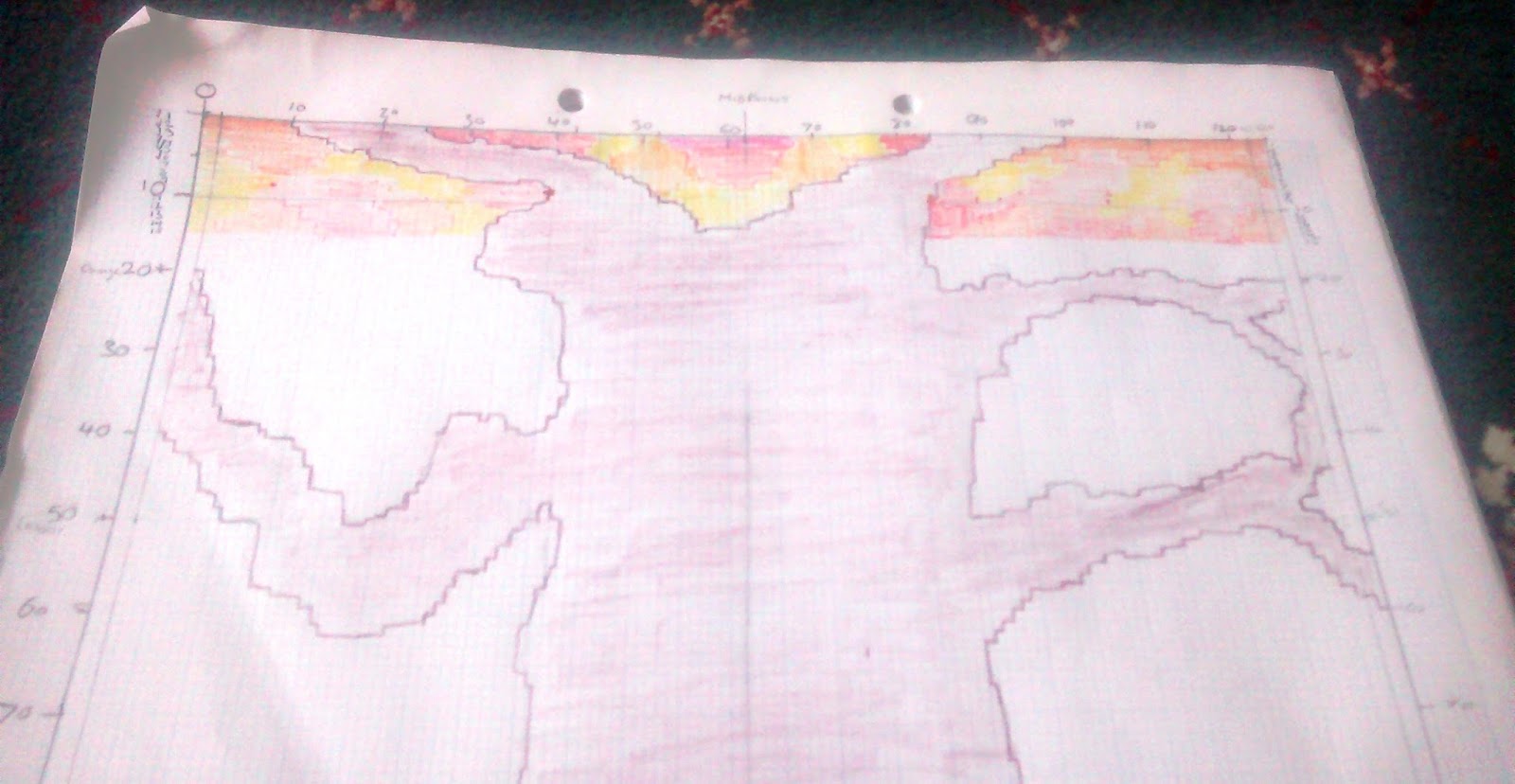
First stage was to redraw the Basic Pattern Design. I made the choice to draw the outline on Chart or graph paper rather than plain. That way I could account for each stitch as I drew the Design.


New Pattern Design 1


I redrew the initial new outline and coloured the trunk of the tree in a reddish brown (should have been dark brown but I picked the wrong colour due to bad lighting).  I was intended to draw the Design in sections rather than from top to bottom. This way I would have more control over its development. 

Therefore if you compare the New Pattern Design with the original one at the top of the page you will find that only the top half of the tree has been designed so far. The Pattern shows the first 80 rows.

However the drawing had a curved outline. In order to make it suitable for translating into a stitch I could use in the Pattern I squared off the Design.

New Pattern Design 2

 New Pattern Design 3

 New Pattern Design 4


Once this had been done I began to add the background colour. Rather than have huge blocks of colour I added small amounts. I knew this would greatly increase the difficulty of what I was trying to do but hey nothing ventured nothing gained!

New Pattern Design 5


As you can see I have only coloured in the first 10 rows of the Design. This is deliberate as I want to see how the Design develops once knitted.  My next step was to transfer the Pattern Design into a working written Chart otherwise I would forever be trying to count the coloured squares.

I started to transfer the pictured data into a written Chart using the system I had devised for the Test Piece described in the Autumn Cape 2016  A long Term Project Part 1.

Written Chart 1


Written Chart 2


Written Chart 3


I got as far as Row 3 when I discovered a major problem. Unlike the previous Pattern where there was a finite number of balls of yarn this Design being more realistic had far more yarn changes and for fewer stitches at a time. 

So yet again I had to go back to the drawing  board and come up with a new system of Charting the Design into a written form that I could follow.

Sometimes the best way to find a solution is to step back from the problem. Therefore I thought I would have a look at what I had to work with and maybe an idea would formulate.

Equipment
As previously stated I had based the Design using a 5 mm Circular needle. I also had a variety of types of yarn - mainly 100% Wool in a selection of colours. I decided to get them out and take a look.


Yarn 9 Full Balls 50g

Yarn 13 Full Balls Mixed Weight Discontinued Lines


I selected the balls I was intending to use for the Casting On and put them in the order that was shown on the Chart.

Balls in order for the Cast On.


I then proceeded to Cast On 124 Stitches in the following order

Copper (Orange) 10
Dark Brown 15
Red Berry 20
Gold 4 (Yellow)
Copper(Orange) 3
Red Berry 16
Copper (Orange) 4
Gold 6 (Yellow)
Red Berry 6
Dark Brown 16
Copper (Orange) 24

Cast On 124 Stitches


The Cast On would reverse the Pattern so I then knitted a single row to correct it making sure that I secured the change of colour by wrapping around the previous yarn.

The next step was to untangle all the balls. If anybody has a good idea how to stop them ravelling up like Spaghetti Junction I would much appreciate it.

Untangled


After I had untangled them all I sat looking at them and the Chart I had an inspiration. Wait for my next blog to see if it worked!